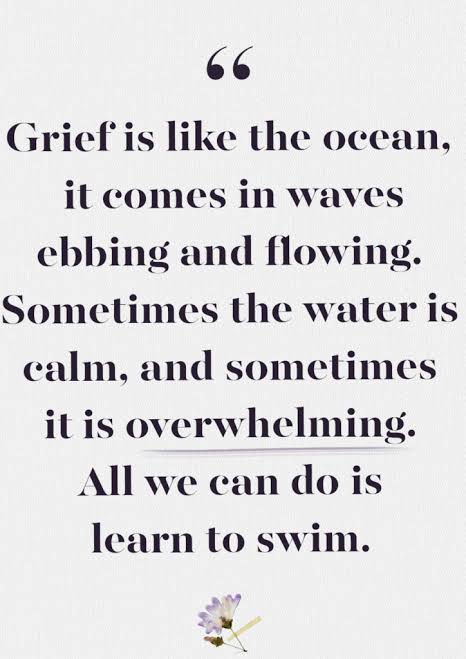
Dealing With Grief;
Hello!
Welcome to another article on A Moment With Jennie. This is another sensitive topic. And this topic is for everybody because at some point we have all had to deal with grief one way or another. Taking from my personal experiences, talking to people who have had to deal with grief abd also after searching the internet, I’ve come up with a few things I would like to share here with everyone reading. Let’s hope my words bring some kind of comfort to anyone reading. Enjoy!
Grief.
One little word and yet to heavy. So broad. So meaningful. Filled with so much pain and heartache and sorrow. But always know that, Whatever type of loss you’ve suffered, there’s no right or wrong way to grieve. But by understanding the stages and types of grief, you can find healthier ways to cope.
What is grief?
Grief is a natural response to loss. It’s the emotional suffering you feel when something or someone you love is taken away. Often, the pain of loss can feel overwhelming. You may experience all kinds of difficult and unexpected emotions, from shock or anger to disbelief, guilt, and profound sadness. The pain of grief can also disrupt your physical health, making it difficult to sleep, eat, or even think straight. These are normal reactions to loss—and the more significant the loss, the more intense your grief will be.
Coping with the loss of someone or something you love is one of life’s biggest challenges. You may associate grieving with the death of a loved one—which is often the cause of the most intense type of grief—but any loss can cause grief including the death of someone, a divorce or a breakup, health problems, financial problems, losing a job or losing a pet, a miscarriage, etc.
Whatever your loss is, it’s personal to you, so don’t feel ashamed about how you feel, or believe that it’s somehow only appropriate to grieve for certain things. If the person, animal, relationship, or situation was significant to you, it’s normal to grieve the loss you’re experiencing. Whatever the cause of your grief, though, there are healthy ways to cope with the pain that, in time, can ease your sadness and help you come to terms with your loss, find new meaning, and eventually move on with your life.
The grief of losing a loved one
Whether it’s a close friend, spouse, partner, parent, child, or other relative, few things are as painful as losing someone you love. After such a significant loss, life may never seem quite the same again. But in time, you can ease your sorrow, start to look to the future, and eventually come to terms with your loss.
The grieving process
Grieving is a highly individual experience; there’s no right or wrong way to grieve. How you grieve depends on many factors, including your personality and coping style, your life experience, your faith, and how significant the loss was to you.
Inevitably, the grieving process takes time. Healing happens gradually; it can’t be forced or hurried—and there is no “normal” timetable for grieving. Some people start to feel better in weeks or months. For others, the grieving process is measured in years. Whatever your grief experience, it’s important to be patient with yourself and allow the process to naturally unfold.
Myth: The pain will go away faster if you ignore it.
Fact: Trying to ignore your pain or keep it from surfacing will only make it worse in the long run. For real healing, it is necessary to face your grief and actively deal with it.
Myth: If you don’t cry, it means you aren’t sorry about the loss.
Fact: Crying is a normal response to sadness, but it’s not the only one. Those who don’t cry may feel the pain just as deeply as others. They may simply have other ways of showing it.
Myth: Grieving should last about a year.
Fact: There is no specific time frame for grieving. How long it takes differs from person to person.
Myth: Moving on with your life means forgetting about your loss.
Fact: Moving on means you’ve accepted your loss—but that’s not the same as forgetting. You can move on with your life and keep the memory of someone or something you lost as an important part of you. In fact, as we move through life, these memories can become more and more integral to defining the people we are.
How to deal with the grieving process;
- Acknowledge your pain
. - Accept that grief can trigger many different and unexpected emotions.
- Understand that your grieving process will be unique to you.
- Seek out face-to-face support from people who care about you.
- Support yourself emotionally by taking care of yourself physically.
- Recognize the difference between grief and depression.
What are the five stages of grief?
In 1969, psychiatrist Elisabeth Kübler-Ross introduced what became known as the “five stages of grief.” These stages of grief were based on her studies of the feelings of patients facing terminal illness, but many people have generalized them to other types of negative life changes and losses, such as the death of a loved one or a break-up.
The five stages of grief;
Denial: “This can’t be happening to me.”
Anger: “Why is this happening? Who is to blame?”
Bargaining: “Make this not to happen, and in return I will __.”
Depression: “I’m too sad to do anything.”
Acceptance: “I’m at peace with what happened.”
If you are experiencing any of these emotions following a loss, it may help to know that your reaction is natural and that you’ll heal in time. However, not everyone who grieves goes through all of these stages—and that’s okay. Contrary to popular belief, you do not have to go through each stage in order to heal. In fact, some people resolve their grief without going through any of these stages. And if you do go through these stages of grief, you probably won’t experience them in a neat, sequential order, so don’t worry about what you “should” be feeling or which stage you’re supposed to be in.
Grief can be a roller coaster
Instead of a series of stages, we might also think of the grieving process as a roller coaster, full of ups and downs, highs and lows. Like many roller coasters, the ride tends to be rougher in the beginning, the lows may be deeper and longer.
The difficult periods should become less intense and shorter as time goes by, but it takes time to work through a loss.
In summary, your grief is your own. Your pain is yours. Don’t let anyone tell you how to feel or not to feel. Don’t let anyone tell you how to mourn/grieve or how not to. Don’t let anyone or anything be a deciding factor as to how you are to grieve. Take your time to heal and move on. Choose how and for how long you want to grieve for. What matters is that, at the end of the day, you heal and you become a better person.
Thank you for spending A Moment With Jennie. I hope this article filled with so much research helps you understand your grief and your feelings and how yo heal from them. Let us spend more intimate time together in the next article. Thanks for reading!
 A Moment With Jennie